
Occasionally I will see someone who has had a whole load of dental treatment carried out abroad.
Very occasionally this treatment has been carried out to a high standard, using good components, and the continuation of the treatment is straightforward.
More often than not, the components are cheap and the work is average at best.
The problem is that to most people, an implant is an implant, it’s like buying a dominos pizza – anywhere you get it, it’s going to be the same. So it makes sense to spend as little as possible because the end result is the same.
Unfortunately, this is not the case, and if you are reading this, you probably know this already because it looks like you are the type of person who likes to do a little research on these things.
So, the story here is that this lady went to India, found a “reputable” clinic, and it looked clean and tidy (similar to our place in Marlow), and she had 7 implants placed, it cost her about £6000, (she also had 4 veneers).
This was 2 years ago, and all the implants are still there, but the biggest problem is that one of the bridges keeps coming off.
 This bridge never felt right, and it has come away twice.
Her own dentist now does not want to replace it, so she came to us to see what we could do.
When I saw the situation, I could see that the work has been done in an “old fashioned” way, I don’t know why the dentist chose to do it like this.
I do know that doing it in the way that it’s been done is cheaper than doing it in the way that we tend to do it for our patients, let me explain the issues so you can see this in the way that I do.
What we are looking at is two abutments (Ignore the pus for now), and these abutments are screwed into the implants.
 There are several types of abutments available, but mass-produced abutments are the cheapest, and the drill marks around the abutments look like these are standard abutments that have been shaped with a dental drill (in the same way we would shape a tooth for a crown), and then a mould was taken, and two linked teeth were glued to these abutments.
The way that we like to make implant teeth is that we like to have the abutments and the bridge (or individual teeth), made as one unit.
This then screws into the implants, and there is no glue.


In this case, the abutments are computer designed, and there is a perfectly smooth connection between the crown and the abutment.
In contrast, with these glued crowns and bridges, there is often a ledge at the junction, and this has been proven to harbor bacteria.
The glue can cause several other issues, the most important being bone loss around the implants, which is what we have here (but Ill get onto this in a minute).
Being glued also means that the fit does not need to be that accurate, because the glue will compensate for some error in the record taking. There are more stages if we have a “screw retained” bridge – to ensure that the records are perfect, and this ensures a perfect fit to the implants.
Okay so back to this photo, the whitish stuff that you see around the implant is pus. Pus is never a good sign, especially around a dental implant.
This implant does not hurt – the patient is unaware that there is a problem (other than a bad taste).
When we checked the gum health, all her natural teeth were healthy, but this implant had a lot of bone loss around it, and the other implants were not looking too great either.
We will talk about the other implants soon.
But on the x-ray you can see the bone levels, and how they dip around this implant.


This is almost certainly caused by the type and quality of the teeth on the implants, and not actually the implants themselves.
The implants are mid-range implants, they are okay, and it looks like the placement is okay (from what I can see on the xray). There is a little bone loss around the other one, but the main bone loss is around the one with pus around it.
So what are we going to do?
We cannot save this implant, we could try, but it would be a much better long term solution to remove it and start again.
This would be quicker, the end result would look better and it would probably be cheaper.
When we remove the front implant, we will check the health of the back one and decide if we are going to keep that one or remove that too.
Once the area is healthy, we can then rebuild the bone, and place a new dental implant.
Once this has healed, we will make new screw-retained crowns (individual) on each implant.
But what about the others?
One big problem with the other implants she has is that the crowns on the implants are too bulbous. In cross-section, they look like this.
Being bulbous like this makes them very difficult to clean, so when we checked the gums, there was far more bleeding around these implants, and her natural teeth were fine.
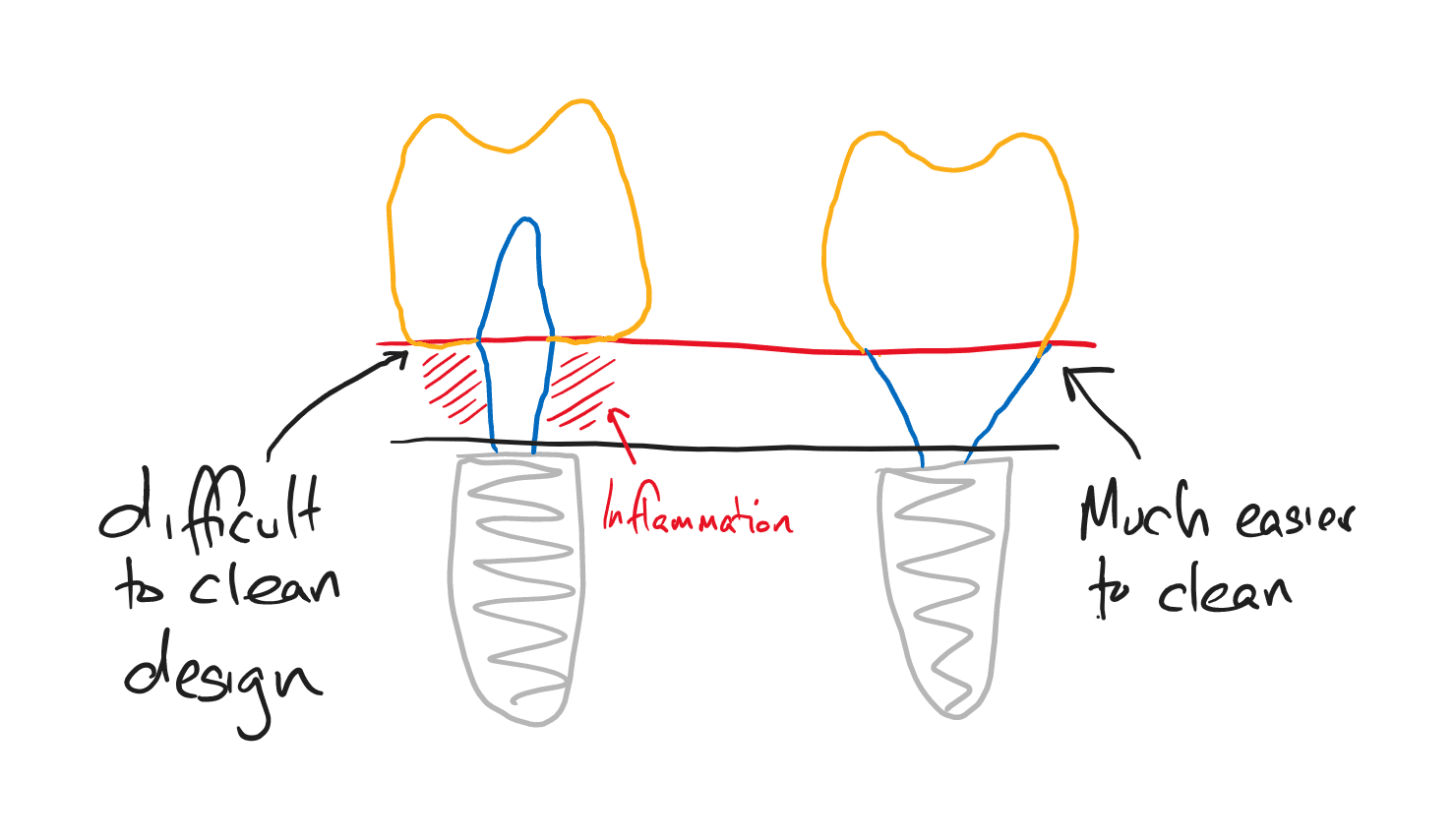 Bleeding is the first sign of gum disease around implants or natural teeth.
So If we ignore this, then the other implants will have the same fate. We want to be realistic with what we should do, and removing all of the implants will be overkill, so we have planned to work with the hygienist to see if we are able to get the gums perfectly healthy everywhere.
If they are still bleeding in 6 months, we will look at other options, and maybe change the teeth on the implants for some that fit better and are easier to clean.


