
How do we design perfect smiles?
When a patient comes to see us, it is very rare that they have a problem which only one treatment can solve. It could be a complex situation where people have missing or discoloured teeth or a lot of other different problems. The end goal is to create a fantastic and long-lasting smile.
With this in mind, we have developed a system of treatment planning for our patients, which is different to the vast majority of dentists. We start with the aesthetics first.
Planning
Firstly, we draw a plan of what the ideal smile should look like. At this stage we do not consider the treatments that will be required to get us there, we just do an outline in the same way an architect would draw plans for a building before construction. Smile design is an art and a science. The principles I am going to share with you in this blog post are universal principles, although every smile is a slight variation on these. Every smile will have its own uniqueness whilst following the same pattern, in the same way that we have all got two eyes, a nose and a mouth, but we all look different.
The length of the teeth
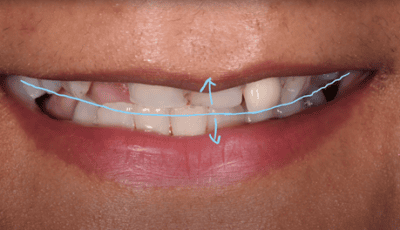
The first thing we look at when we design a smile is the length of the teeth. This is arguably the most important feature of a smile to get right. Everyone shows a slightly different amount of tooth when they are talking.
A lady would generally show more top tooth than a man of the same age, and younger people will show more tooth than older people. As we get older, we show less top teeth and more lower teeth. We therefore must have the length of the teeth to be age appropriate. Often when we are trying to rejuvenate a smile, we will add a little bit of length to the front teeth in order to get that younger appearance. People often look older if they have got heavily worn-down teeth, mainly because of the amount of tooth which is on a show when they talk and smile.
The midlines
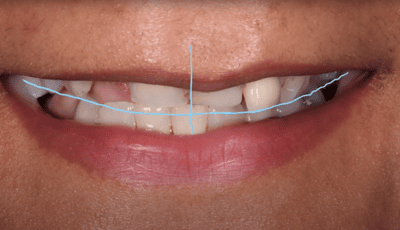
The next thing to pay attention to is the midline. A lot of people get overly focused on the midline but it is not actually as important as you might think.
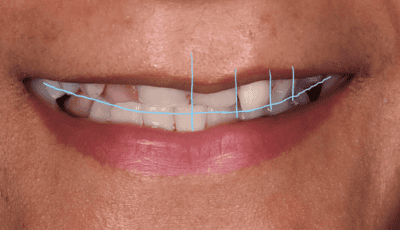
The position of the midline does not need to be in the middle of the face. It can be off centre by up to three millimetres and it is very unlikely anybody is going to notice this. Additionally, top teeth midline and bottom teeth midline do not need to be exactly on top of each other. What is important about the midline is whether it is straight up or if it is canted (a slanted or oblique position) left or right. A canted midline is extremely noticeable. This is something that we need to look at in order to straighten the midline to create that overall great looking smile. After we have got the midline correct, we can then pay attention to the width of each tooth. The width of each tooth again is derived almost with a mathematical formula.
The Golden Proportions
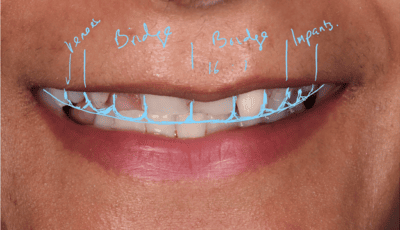
Golden proportions are known to be naturally pleasing to the human eye and this helps us visualise how much tooth should be on show when looking at the smile front-on. If we give the front tooth an arbitrary value of 1.6, we want the next tooth to be 1. In other words, we want the front tooth to be 1.6 times bigger than the next tooth along. This pattern follows all the way to the back teeth. Once we have the width of the teeth, we then decide where the gum line needs to be. The gum looks best at the same level, so the top portion of each tooth needs to be roughly in the same line. Now that we have got the bottom edge of the tooth, the top edge of the tooth and the width of each tooth, we can now connect the dots.
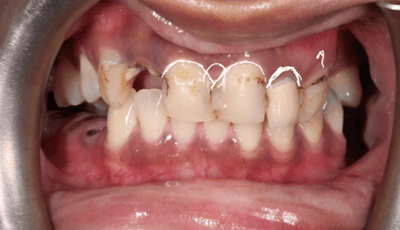
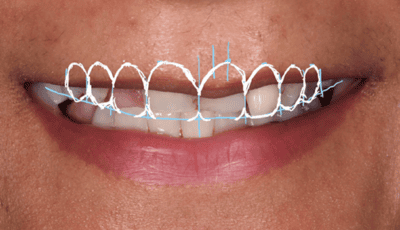
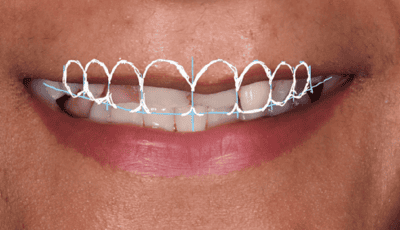
Each corner of each tooth has its own unique feature. Firstly, we draw the highest point of the tooth which is not in the middle of the tooth but a third of the way towards the back of the tooth. That will give us the arch form of the gum on each tooth. Then we draw corners at the bottom of each tooth. Each corner of the tooth has a different radius and a different amount of curvature. The overall curvature of the teeth is customised to each person. Rounder teeth have a more feminine, softer appearance, whereas squarer teeth have a bit more masculine, dominant appearance to them.
Our aim is the middle corner of each tooth to be a little bit sharper than the back corner. This helps us achieve a natural looking smile.
The aesthetics
Up to this point, I have only written about the aesthetics. We have not discussed the treatments related to how we are going to achieve this. We can use implants, veneers, bridges, tissue grafts, bone grafts and laser treatments; there are so many different options.
It is all of these outlines of the teeth being in the right place which creates that overall beautiful, natural looking smile. The kind of smile where our patients look like they were just born with fantastic teeth. It is not un-natural looking, or like someone has just had a ‘Hollywood Smile’ that is bright white wall to wall veneers.
We want to create natural looking beautiful smiles, and this is how it all starts.
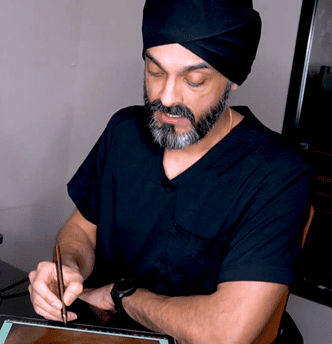
With a pen and paper and just outlining the look of the smile.


