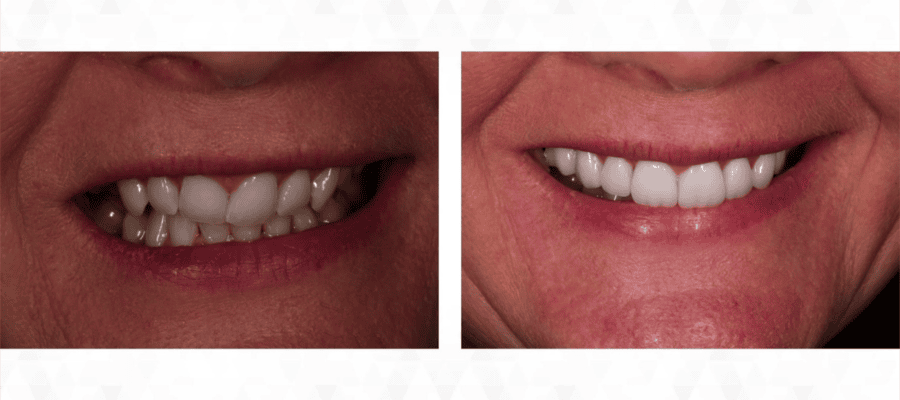
Cosmetic dentistry is extremely popular these days when everybody is looking at themselves on Zoom or taking selfies on Instagram.
It’s really easy to see how your smile could be improved, and hence, lots of people are looking for ways to improve the look of their smile.
Porcelain Veneers have generally been one of the most advertised ways of improving your smile, it’s probably the gold standard and it’s the kind of treatment which most celebrities have in order to really boost the appearance of their smile.
Now it’s important to remember that Porcelain Veneers are not just an off the shelf item- they are a medical procedure and therefore they’ve had their own risks and benefits, and the number of veneers that you have done will vary on every situation.
Now I’m a believer that we should always do the least amount of treatment possible in order to achieve the maximum results for my patients.
One way we do this is we take lots of detailed photographs and during our consultations, which last about two hours, we will discuss how many teeth need to be treated, the costs of having all of this done, and what is the minimum amount of treatment that we can do to achieve the results that the patient is looking for.

Now saying this, sometimes it’s actually better to have more treatment. You see by treatment, I don’t mean the number of veneers that you have done, I actually mean the amount of drilling, which is done to the teeth, because this is the irreversible part.
Once a part of your tooth has been drilled off, there is no way of getting that back and in some cases, if too much is drilled off we are going to weaken the tooth significantly.
The problem here is that if you weaken teeth too much, like you’ve seen the photos of people who have their teeth done in sketchy places abroad, then you’re introducing more complicated problems later down the line. Teeth which are heavily reduced, will be much more likely to need root canal treatments or maybe early extraction and replacement with implants.
So really you’re committing yourself to a lifetime of dentistry.
Now, there is a way to have veneers without these complications, and this is by using minimal prep veneers. So ‘prep’ means preparation. So preparation to the teeth, that’s what we’re talking about. Now, let’s have a look at this case where we did four units.
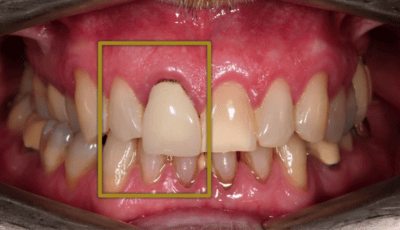
The main concern for this patient was the look of these two teeth. And it is possible just to change them, so one of these is a crown. So this has already been reduced in the past, and the tooth has a crown on it, (which is a veneer, which wraps all the way around the tooth). So we can expect that when we lift this off, the tooth underneath will look like a little peg.
The tooth next door has never had anything done to it, so this could potentially have a veneer. However, we need to look at something else.
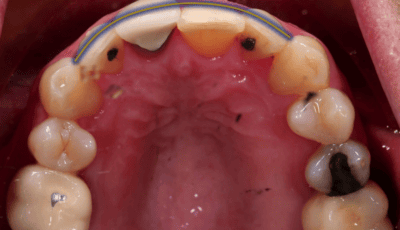
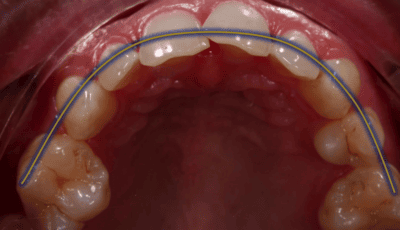
We need a bird’s eye view of the teeth, and this will show us something called the arch form.
The arch form is essentially the semicircle line that we can draw, which goes through the outside surface of the teeth.
Now, one of the problems that this patient had was that the crown looked too proud and it was too far forward. Looking at this photo, you can see that it is forward in relation to the other tooth on … the same tooth on the other side.
If we’re creating a great smile, we want to get these two teeth parallel to each other. We want to get them in the same plane in the same arch form.
And if we took off the crown and then we reduced the tooth underneath even more, we’re getting dangerously close to the nerve, and we’re going to create more long-term problems for this patient because of this.
Now a way around this is actually to do more teeth. So here we actually did four teeth, and we pushed the arch form out, and we accepted the position of the most furthest out tooth. And what this meant was we didn’t need to do any reduction on the teeth either side, and they were almost what we call non prep.
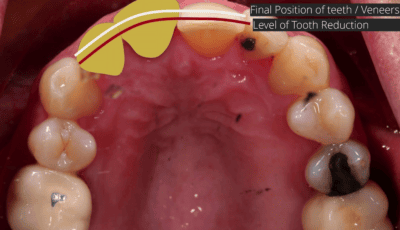
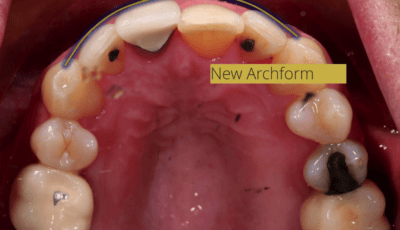
Non-prep means that absolutely no teeth adjacent was carried out, but in reality, there’s a minimal prep because a tiny bit of tooth removal adjustment does have to happen, and it happens at the corners of the teeth.
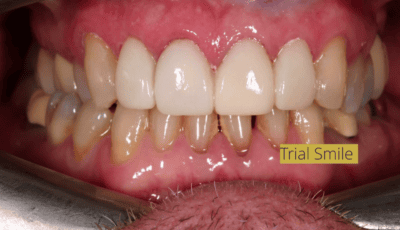
So this was done, we built the teeth up in temporary materials first, and we made sure the patient liked the look of the smile.
Once he was happy with the temporaries, we then converted this to porcelain, and that’s how we created the smile, with doing very, very little additional adjustment to the teeth.
Now, in more complicated situations, we can do this for more teeth. So if you’re considering having porcelain veneers done, and if adding to the front teeth will make the front teeth look too dominant, we can actually include more teeth, so a full smile is typically 10 to 12 veneers.
And if we increase the arch form of the whole top set of teeth, with them able to do a full smile design with very little tooth preparation.
This has got a number of advantages.
Not only does this mean less reduction, less weakening of the teeth, less long-term complications, but also if we’re gluing to the enamel of the tooth, which is the outside surface of the tooth, we know we’re going to get a much stronger bond, which means that the veneers are typically going to last longer.
Now this isn’t always the case, sometimes we’d still need to do adjustments, but the general trend is we try and do as little adjustments as possible to achieve these maximum results.