Last week, I was having lunch and overheard the hygienist and my nurse talking when the subject of sales came up.
One said that she wasn’t good at sales, because she is too ethical, and feels uncomfortable lying to someone to get a sale. The other soon agreed.
She then went on to say that when she worked in retail, in a clothing store, they were encouraged to tell their customers that what they were trying on looked really good, and this would help them to get the sale, and hit targets.
This is where I think the problem is. She has now associated lying with sales.
She now thinks that putting your own desires (for money and hitting targets) in-front of your customers’ needs is what sales is.
Most people (especially those in healthcare), would feel uncomfortable with this – I know I would!
What is sales?
Now, in my day to day dentistry, I know I am being a sales person, but my perception of what a sales person is – is very different.
Firstly, I have to focus 100% on what the patient in my chair wants, and why they want it.
To do this takes on average a 40-minute conversation – and why they want xzy is far more important than what they want.
So, for example, someone might want to replace a tooth, and they have done some research on Google, found out that most dentists are talking about dental implants as tooth replacements.
So when the patient calls your clinic, they will say – “hey, I would like a consultation about dental implants.”
Okay, great – that’s easy now – let’s just talk about dental implants and bridges and removable dentures right?
Well, I would suggest taking it a step further. Find out why they want that tooth replaced. It could be that this missing premolar is making the patient feel self-conscious when smiling.
As a dentist with an interest in cosmetics, you might see a bunch of other things, ugly crowns, chipped incisal edges and dull teeth in addition to the missing tooth.
Communicating the big idea
Now, we need to communicate this with our patient in a professional way, and understand if this bothers them.
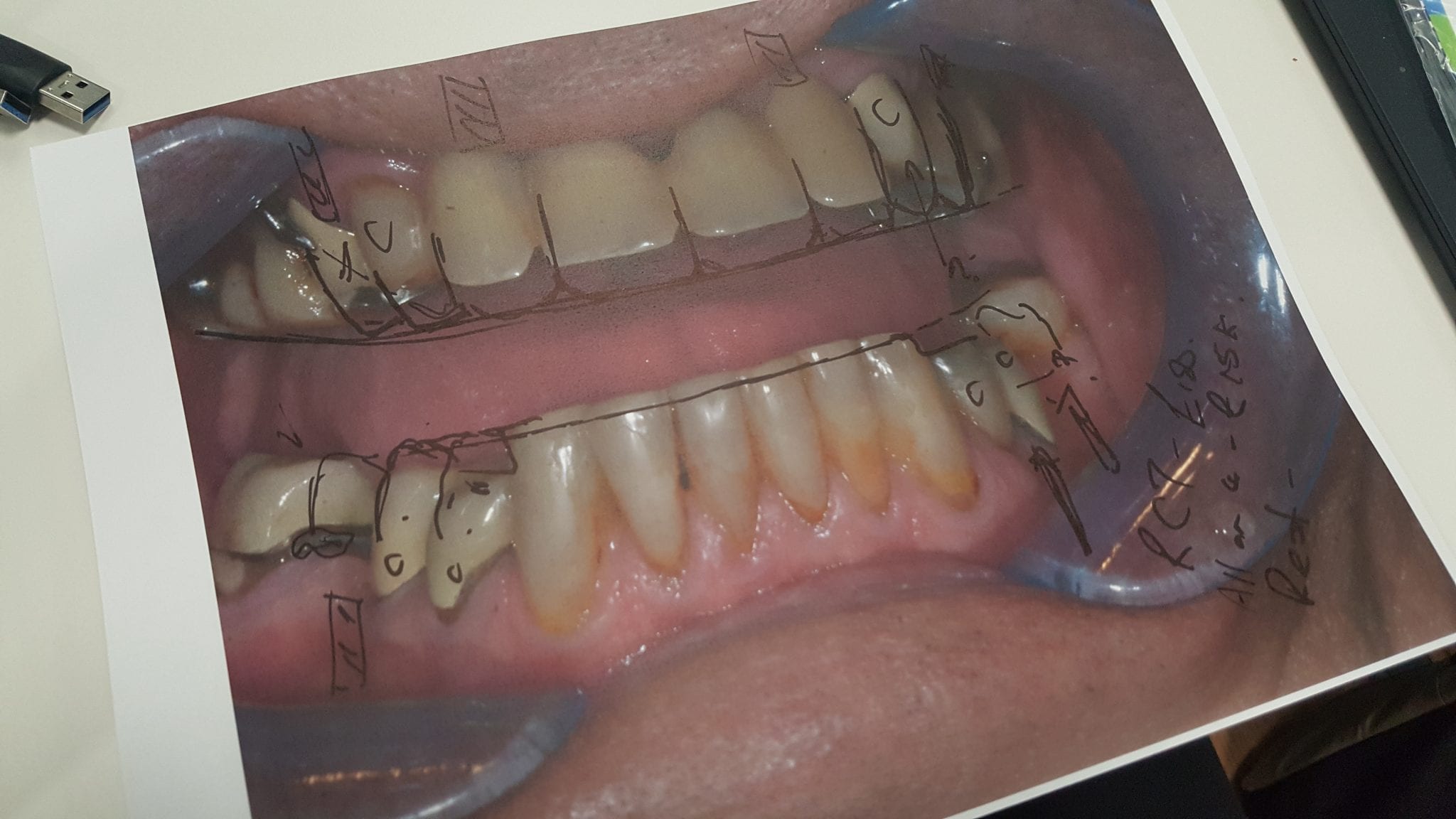
The way I approach this is by taking a set of pre-op photos before seeing the patient, and having these printed out.
I can then agree with the patient. This tooth they are ‘in for’ needs replacing because the space is visible when they are talking and it doesn’t look good.
Now, because I have had that 40 minute conversation, and he has told me that having a missing tooth is affecting his confidence, I will then draw his attention to the things that I see when I look at his smile.
My goal is not to make him take up a big treatment plan, but it is to make him feel great about smiling again!
It might be that all he needs is a tooth replacement, or he might want to do something more comprehensive.
To get onto this conversation, I use what I call, an escape question.
This is a question that if the patient says yes: then I know they want to talk a bit about cosmetics and may take on board my opinion.
If they say no – then I know to just move on.
The question is something like this:
…So, there are a few key things to think about when you want to make a smile look really good, would you like me to go over a few of these with you now?
That’s it!
Most people will say yes, and this gives you an opportunity to talk about cosmetic dentistry.
Because they have said yes to your question, they feel like they are in control, and asked for this information.
If they say no – then don’t talk about it anyway!
They may say no for a whole bunch of reasons. It doesn’t happen often, but if they do say no don’t take it personally – it just means that you need to replace the missing tooth!
When they do say yes, I will then draw a smile design on the photograph.
 Doing this does many things.
- It educated the patient in smile design
- It positions you as an expert (no other dentist has done this for them and gone into so much detail)
- It empowers your patient to make the right decision for their whole smile and not that individual tooth.
Now, as dentists, we know that redesigning the smile will be much easier if its all done in one go and doing bits here-and-there really doesn’t work.
If your patient really wants more than replacing that one tooth, and their budget permits it, then by not talking about this other stuff, you are actually underselling them
If they opt to have more comprehensive stuff done at a later date, then it is possible that the crown on your implant will need replacing to fit with the new smile – hence you could be wasting their time and money!
Finding the right solution
In my opinion, sales is about finding the right solution to your patients needs.
To do this properly, we need to find our patient’s real needs. Not what they initially say, but really get to the bottom of the problem.
If we go back to my hygienist working in retail, then if she thought her customer looked terrible in a dress, she should say that. Maybe something like this;
“I don’t think this dress is right for you, this shape doesn’t complement you enough, can you see… (whatever isn’t right with the look). Do you mind if I show you something that I think would work better?”
The new dress might be more expensive, but who cares? We are trying to solve a problem, let’s explore all the options first, within a realistic budget and take it from there.
Personally, I hate it when I buy something, only to later find out that I could have had something better if I had paid a little bit more. Some of our patients will feel the same way!
When talking about treatment plans, the cost difference can be significant. So I always try to be as upfront about the costs as possible, even at the treatment plan discussion stages. This means my patient is always in control of the treatment fees as well as how much treatment they have done.
I hope you can see that there is nothing sneaky going on behind the scenes. In fact, I am posting this on my blog on my website, which is where a lot of potential patients find me! It makes no difference to me if the patient goes ahead with treatment, or not.
Well, actually, that’s not quite true, I really want them to go ahead with treatment.
If they don’t – that means that I have wasted their time. Someone has come to me with a problem, and I have not been able to solve it.
This is a failure in my book!
I think that if you focus your energy on helping the person in front of you and communicating with them in a way that they want to communicate, then you can’t go far wrong.
 This is a massive shift in the way that dentistry was taught to me– where the dentist knows best and the patient must listen to what the dentist says!
Sales is a complex subject, lying to patients to get them to sign up to big plans will only cause you problems in the future – I prefer a more relaxed approach, where the patient is in control and makes all the key decisions, I can just guide them in the direction I feel is right.
Let me know what you think – you can get in touch with me on my Instagram Page or just leave a comment below.
Get Blog / Cases to your Inbox
If you want to be notified by email when I post a new case, just click the button and fill in the form