Lets talk about Anchorage in Orthodontics.
This is a basic concept, but can get fairly complex, so lets keep it simple.
If you have two object, one is a small marble, and the other is a football. Now imagine you could connect the two with a tight elastic band, and let go. What would happen?
Well, the marble would probably fly into the football. If you were watching carefully, the football will have also moved, but not so much. This is because the football has more mass than the marble.
If you want to revise about Newtons Third Law, here is a good little video to help you:
Now you understand this law, how does it work in dentistry?
If you have a fixed brace in position, and you put a powerchain from a molar to a premolar (with a space between), then the premolar will move more than the molar. This is because the molar has a greater root surface area to resist the force. If you connect the two premolars, and molars together, then use their combined force to pull against an incisor, then you can be pretty sure the big block of teeth are not going to move far, and most of the movement will be in the incisor. The big teeth are ‘anchored’ in, and this is the concept of horizontal anchorage.
It is horizontal, because this is the direction of the forces.
So, vertical anchorage is the same thing, just in a vertical orientation. Let look at a case where this is important…


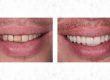
This patient did not like the upper left canine, its rotated, and much higher up than the other teeth.
There are a bunch of things that I needed to do in this case, but lets focus on the vertical anchorage.
The canine is a big tooth, with a relatively long root. Newtons law states that every force has an equal, but opposite reactive force, so to pull the canine down, we will exert an equal (and opposite in direction) force to the other teeth. You might be able to guess what it looks like after a few months.

It looks like I’ve introduced an occlusal cant! The most important thing here is: Don’t Panic!
This wire is an 0.018NiTi, so there is some flexibility in it. For this reason, the teeth either side of the canine have been intruded a little bit, while the canine has been extruded.
This is making the whole occlusal plane look canted.
This is quite easy to fix. The problem is that the ‘opposite’ force is allowed to act on 1-2 teeth either side of the canine, because of the flex in the wire. If we put in a wire which does not flex so much, then the ‘opposite’ force will be spread over more teeth. So this is exactly what I did.

After a few months in a rectangular steel wire, you can see the cant is dramatically reduced. We waited a little longer, until it was perfect, then did our finishing refinements and debonded the case.

Let me know what you think, just leave me a comment below 🙂