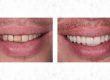

When you start to get into orthodontics, you will see that the type of brackets that you use will become very important.
To cut a long story short, the quality of your brackets will determine the quality of your end result. This is true for complex, or simple orthodontics. I am going to focus on good quality ceramic brackets in this blog article, and hopefully explain the concept of self ligating to you in a clear way.
What is a Self Ligating Bracket?
Self ligating means that the bracket connects to the wire without the need for elastomeric ties or quick lig metal ties.
One of the most famous self ligating brackets is the Damon system. With this system, the bracket has a little door that slides open, you then place the wire into the bracket slot, and close the door.
The main point to understand is that these brackets hold the wire passively (Lets assume we are only dealing with wires up to 0.018NiTi). If you use a normal ceramic bracket, with an elastomeric tie, the wire is normally pressed into the bracket.
The difference here is that the bracket has much less friction to move along the wire.
Why is all this important
The importance of all this is open to debate, and I have to say that you can pretty much do everything with traditional ceramic brackets, but there are instances where I prefer to have self ligating, principally to save time.
So, with the self ligating, there is less friction between the wire and the bracket, so with any sliding movements, it should be quicker to use the self-ligating rather than normal ligation brackets.
Another important feature of these brackets is that there is no staining with food. Patients who are having ceramic brackets do not like the staining so much! The Damon Clear brackets are pretty good looking, whereas the 3M Clarity SL have a metal insert, which is visible.
Saying this, both the Damon and the Clarity SL brackets are more bulky than the standard brackets, and this is something that some patients will dislike.
When Might Self Ligation be an Advantage?
So I’ve already said that I use self ligation for sliding movements. By this I mean any case where you need to close spaces: extraction spaces or spaced teeth.
When going through the treatment of an extraction case, first, the levelling aligning takes place. Then space closure.
During levelling and aligning (which is the extent of most cosmetic ortho), there is no real advantage to self ligating brackets. When you are closing spaces, it would be an advantage to slide the brackets over the wire like a curtain rail.
It is important to remember that as you increase the wire size, the wire will engage more into the bracket. The bracket width is normally 0.022in, so as you start on rectangular wires, although the wire is still passive, the corners of the rectangular wire will engage, and hence increase friction.

Ok, so in this picture, its showing an active vs passive self ligating brackets, but the principle is the same… I’m not going to over complicate things by talking about these!
What are the disadvantages of self ligation brackets?
You may remember from your STO course, that you need to fully engage the wire into the bracket. This is why we use quick ligs if the normal elastomeric tie does not fully engage the bracket.
This means that until you are in a nice thick wire, the full prescription of the wire is not going to be expressed fully. This means that for most STO cases, the levelling and aligning may not be quite as accurate!
In Conclusion…
Its a good idea to know about what self ligating brackets are, but most people who read this are probably going to be general dentists, who do some ortho, so there is not really a massive need for self ligating brackets.
I know some dentists will use Damon brackets, just because they do not stain, and they can leave their patients longer between visits. They feel this is worth the extra cost. Remember that you may still need to use powerchain with these brackets, so there can still be staining.